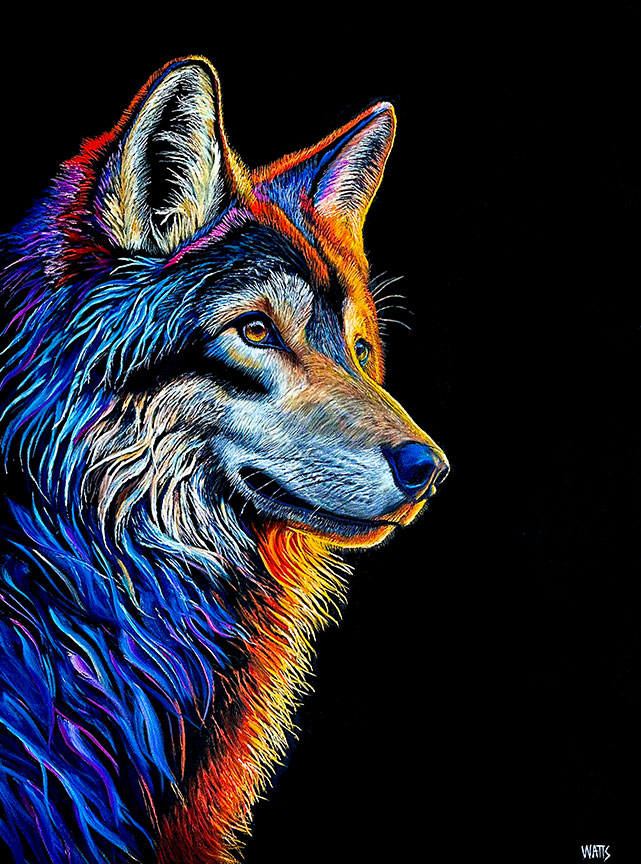
Canadian wolf art portrays wolves as animals shaped by intelligence, social bonds, movement and habitat—not only as symbols of wilderness. Effective wolf paintings use anatomy, posture, gaze, group relationships and environmental context to move beyond familiar myths of menace or mysticism.
01
The problem with the generic wolf
The wolf carries an unusually heavy burden of story. It is cast as villain, guardian, loner and icon. Artists can deepen the subject by returning to observed qualities: long-legged movement, attentive ears, winter coat, social coordination and the subtle distance between caution and curiosity.
02
What painters can communicate
- A frontal gaze creates direct psychological encounter.
- A profile emphasizes alertness, scent and movement.
- A pack composition can explore social structure rather than spectacle.
- Habitat and weather locate the animal within an ecological system.
- Non-naturalistic colour can carry energy while anatomy maintains credibility.
03
Coastal and interior contexts
Wolves occupy varied Canadian environments. In British Columbia, coastal and interior contexts differ in available prey, movement and habitat. Art that claims regional specificity benefits from research rather than relying on generalized mountain scenery.
04
Luminous Guardian as an example
Graham Watts’ Luminous Guardian is a large oil painting centred on a watchful wolf emerging from a dark field. Electric colour and controlled detail around the eyes turn the work into an encounter with an individual presence. It is expressive portraiture rather than a documentary habitat scene.
05
Collecting wolf paintings
Ask whether the work depends primarily on symbolism, natural history, atmosphere or portraiture. None is inherently superior, but knowing the artist’s intention helps you judge whether the choices feel coherent.
Reviewed August 10, 2026 · Editorial policy